SHOT | Article Moonassi

Moonassi
Moonassi Shot Magazine Interview Paintings
0:00
--:--

Moonassi

Drawing, Painting the Unsaid

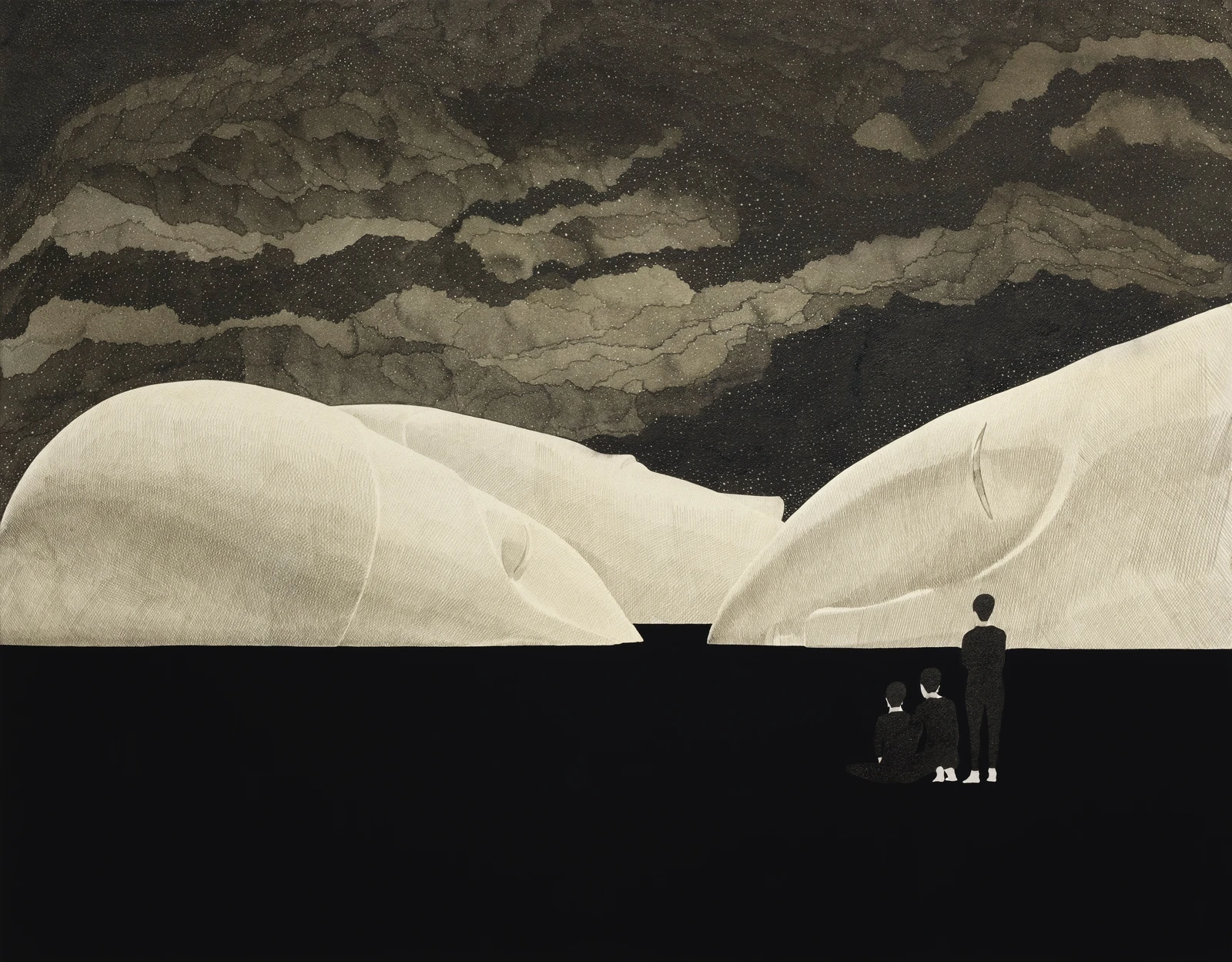
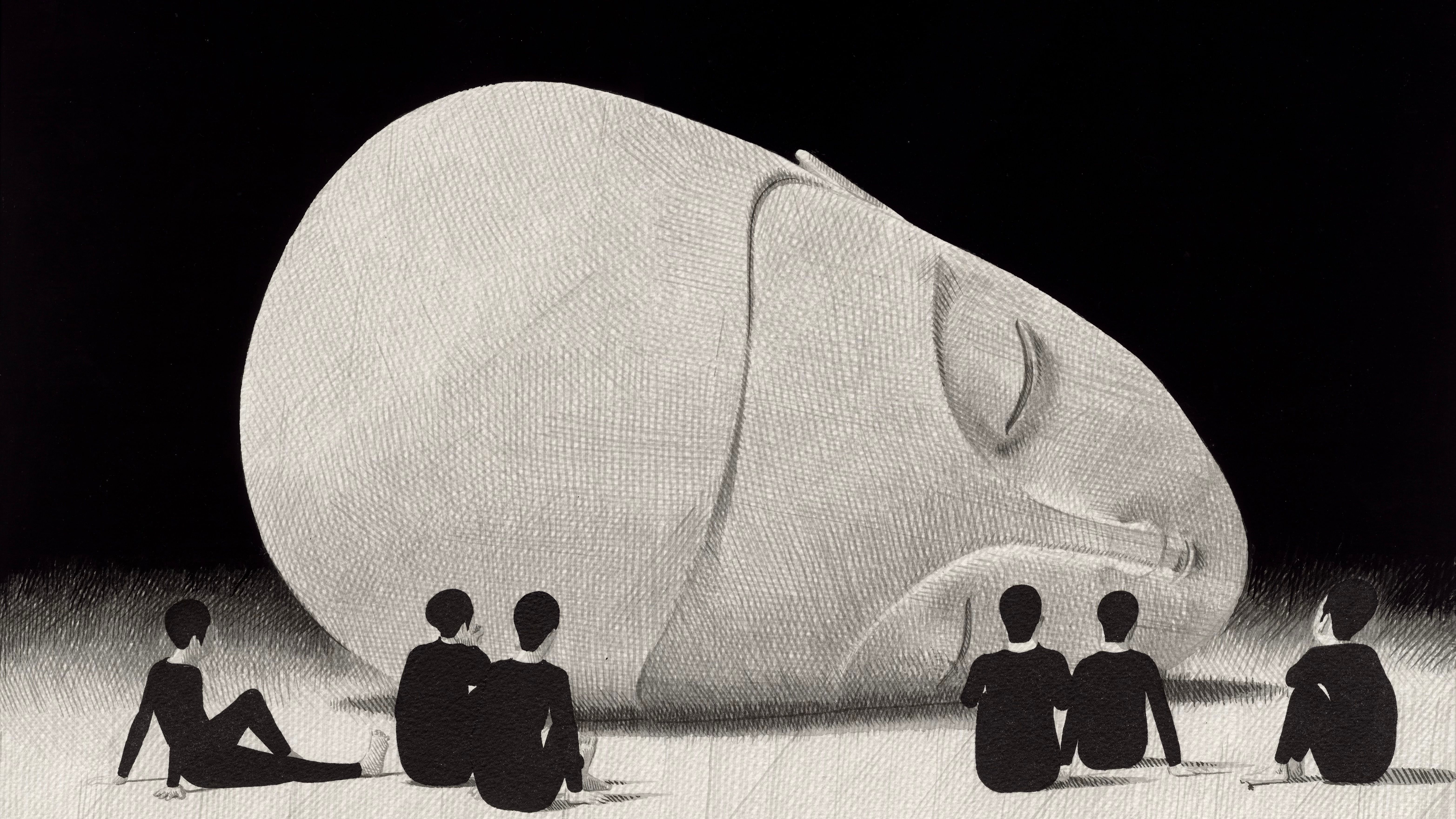
Between black ink and white paper, Moonassi builds a language that feels like a silent diary. His lines fall lightly, holding invisible tensions, memories, contradictions, thoughts that do not need to become explanations. Faceless figures emerge from the background not to tell a story, but to welcome the stories of those who observe them. Black, a constant presence in his work, does not close but opens up, holding shades that shift with the light, with time, with each gaze. Moonassi does not seek conclusions or fixed messages. He chooses the simplicity of tools and the complexity of perspective, letting the work remain, speaking quietly in his place.

Moonassi Shot Magazine Interview Paintings

I would like to begin with what feels so defined in your work: paper, ink, essential gestures, spaces that speak. How did this language, at once essential and profound, take shape and continue to accompany you today?

Since I was young, I’ve always been more interested in the essential than the superficial. That may come from reading Laozi, Zhuangzi, and Indian philosophy early on. During university, while others experimented with new materials and expressive techniques, I didn’t think that was very important. If the story in the drawing was strong, any material would do. So I spent more time on the ideas and simply used paper, pen, or marker. Later, I started using ink—not for symbolic reasons, but because black felt like the most basic way to represent something. Ironically, while I didn’t focus on techniques, people seemed to find that simplicity unique.

Black is the color that dominates your artistic exploration. It is not absence, but density, depth, and silence. What does black represent to you? And has its meaning changed for you over time?

I don’t want to attach too much mystery to the color black. I just feel that it’s enough. It offers endless possibilities without needing other colors. I think my love for black may be similar to why I enjoy the night. In darkness, I feel more connected to myself. Boundaries fade, and everything becomes soft and blurry, like being underwater. That atmosphere is something I really like, and I believe it comes through in my work.
Moonassi Shot Magazine Interview Paintings

Your artist name, Moonassi, was born from the Buddhist concept of the absence of ego. And yet, every work carries traces of its creator. What do you feel remains of you within your drawings?

My work holds many sides of me: the parts that fear the past, struggle in relationships, feel sadness and loneliness, and also enjoy being alone. Recently, I’ve been trying to remove as much of myself as possible from my drawings. I aim to draw emotionless figures, just as forms.

When people call you Moonassi, what do you feel they are truly calling?

Not many people actually call me by name, and those who say “Moonassi” are usually gallerists or viewers. So I assume they’re referring to me as an artist. Since the name means “no me,” it still feels a bit amusing—like they’re calling someone who doesn’t really exist.

Moonassi Shot Magazine Interview Paintings

Your figures have no defined faces, yet they speak profoundly. What are you seeking in these bodies suspended between presence and absence?

Like scientists mapping the brain to understand the mind, I think I’m drawing a map of emotions from inside myself. If I understand my own emotions better, maybe I can understand others too. So in a way, I draw to understand myself and to have better relationships with others.

Have you ever dreamt of one of your drawings before creating it?

Not in a dream, but I sometimes see completed images in my mind during the day.

You once mentioned that you don’t expect the meaning you place in a drawing to reach viewers exactly as you intended. But when you draw, are you seeking to clarify something for yourself, or do you allow the drawing to remain a mystery even to you?

Usually, I begin with a clear idea. But as I continue, I sometimes hide or twist the meaning, even from myself. I don’t draw to release emotions I already understand. Instead, I look forward to discovering something new through the process.

Moonassi Shot Magazine Interview Paintings

If you could inhabit one of your own works, what kind of reality would it be? Would it feel comforting, unsettling, surreal, silent? And why?

Since my drawings are full of my own stories, being inside one might feel like a terrible nightmare. When I created the name “Moonassi,” I hoped to move away from myself and create something not just about “me.” I know that’s impossible, but ideally, I’d like to enter a scene where I could observe from a distance—free from emotional conflicts.

You have once said you wish to live freely and serenely. What does “freedom” truly mean to you today?

Freedom, to me, is a state where no one around me feels uneasy or sorry because of me. It’s not something I can feel alone anymore. True freedom now means peace shared with the people I care about.

More interesting

Le Fawnhawk Shot Magazine Interview Desert

Le Fawnhawk

The desert taught her to remove, to recognize the shape that silence can take. In Le Fawnhawk’s work, essential geometries rise like portals between earth and sky, suspended between reality and dream, in dialogue with the landscapes that hold them. Each installation becomes an invitation to slow down, to observe, to reconnect with that sense of inner vastness so often muted by the noise of the world. For Le Fawnhawk, beauty is not found in perfection but in honesty, in aging materials, in solitude that speaks, and in the marks that remain.

Kristian Schüller Interview Shot Magazine Issue16 Fashion Art Photography

Kristian Schüller

Behind every photograph by Kristian Schuller lies a question: who is the person truly standing in front of the lens, where do they come from, and what story do they carry? From this curiosity, his visual language takes shape, one that blends discipline and spontaneity, allowing imagination to complete what the image suggests without ever fully revealing it. For Kristian, photography is never just an image but a suspended fragment of a larger narrative, an invitation to get lost in the nuances, contrasts, and tensions held within each frame. Preparation and instinct coexist on set, where every detail is meticulously planned, yet space is left for the unexpected, because it is within that margin that the image truly comes alive.

Osman Ozel Interview Shot Magazine Issue16 Fashion Art Photography

Osman Özel

Osman’s gaze is a silent collision between ancient echoes and contemporary tensions, a search for stories that move beneath the surface of light and shadow. His practice unfolds in the layered dance between long exposures and the movement within each frame, where time does not freeze but stretches, revealing invisible narratives held within a single shot. His approach to photography is an act of breath and suspension, a ritual where light meets movement and illusion begins to take form. For Osman, photography is not about capturing beauty alone, but about building atmospheres and creating tension.

Tamara Kvesitadze

Tamara Kvesitadze’s work moves within a constant balance of opposites: stillness and motion, presence and absence, matter and body. Her sculptures are not merely objects to be contemplated but intimate encounters, thresholds connecting the subconscious and the conscious. Raised in a context that imposed silence and immobility, she chose to respond through gesture and transformation. Her kinetic sculptures move in infinite cycles: they open, can be crossed, dissolve, and reassemble, creating spaces that remain alive and in perpetual motion. For Tamara, the body is more than a surface; it is an archive of memory, wounds, and resilience. Her forms shift and recompose, becoming mirrors in which we can find or lose ourselves. In a world that seeks conclusions, Tamara’s works invite us to remain within the flow, suspended on that subtle line between clarity and ambiguity.

Andres Reisinger Shot Magazine Interview Take Over Series

Andrés Reisinger

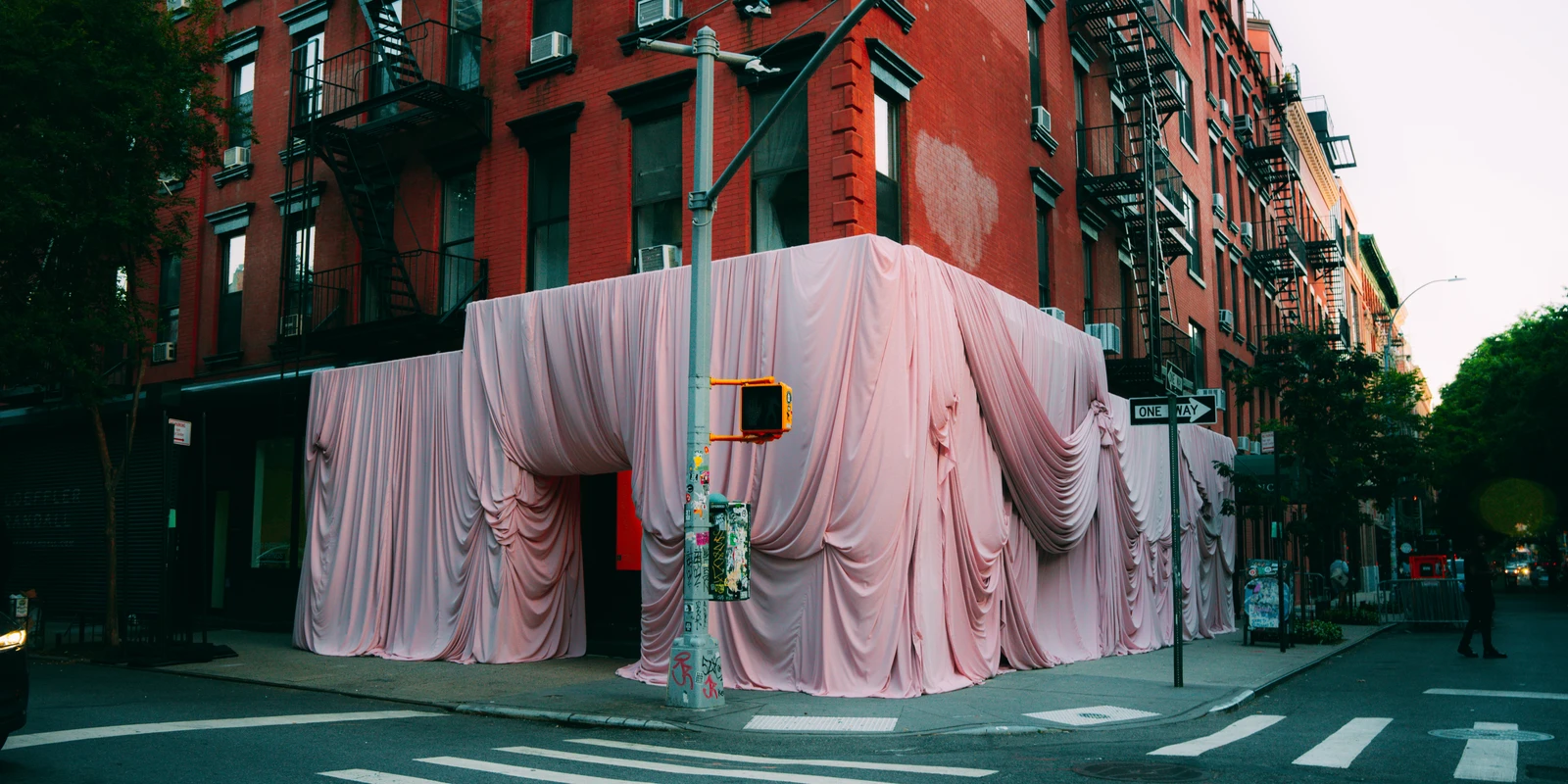
Visual artist and designer Andrés Reisinger creates works that inhabit the threshold between the real and the digital. His practice spans installations, objects and images, blending technology, artificial intelligence and a handcrafted sensibility, transforming spaces and forms into experiences suspended in time. Pink is a recurring signature in his visual vocabulary, a tool for emotional exploration that moves between memory and imagination. Rather than illustrating future worlds, Reisinger expands our perception of the present.

Alien Wang

The essence of Alien Wang’s imagery lies in a silent dialogue between reality and the surreal. A Taiwanese-born photographer and director, Alien merges fashion with industrial elements and conceptual storytelling to craft immersive visual narratives. For him, photography is not a fixed language but a living mirror, an emotional process where colour becomes psychological projection and light channels energy. His work flows through unstable states of perception, oscillating between dream and presence. Rather than guiding the viewer’s gaze, he embraces ambiguity, allowing instinct and invisible forces to shape meaning.

Samo Shalaby Shot Magazine Interview

Samo Shalaby

Samo Shalaby paints worlds where excess meets precision and beauty is laced with disillusion. His canvases, dense with cultural references and symbolic detail, defy linear narrative. Instead, they open portals as dreamlike visions where reality and fiction blur, and every element becomes a clue to decipher. Beneath the opulent aesthetic, every gesture is deliberate, every figure layered with meaning. For Shalaby, painting is an act of remembrance, a personal language that holds contradictions, heritage and desire. His work invites us to slow down and look deeper, beyond the surface, into the symbol. 

© 2026 SHOT. All rights reserved.

Terms of UsePrivacy PolicyCookie Policy

© 2026 SHOT. All rights reserved.

Terms of UsePrivacy PolicyCookie Policy