
In Meghann Riepenhoff’s work, the image is born from an encounter that can never be fully predicted. Light-sensitive paper comes into contact with water, wind, sunlight, sediment, frost, living matter, and retains what happens across its surface. There is no camera mediating the gaze, but a direct exposure to the world and its forces. Each work becomes the trace of an unstable relationship, where the artist’s gesture coexists with what escapes control. Light continues to act, time continues to transform, the landscape continues to leave its marks. In this physical and uncertain space, the image does not represent nature: it carries its movement, its pressure, its memory.
Your work resists almost every conventional expectation of photography. Can you describe how you make your images?
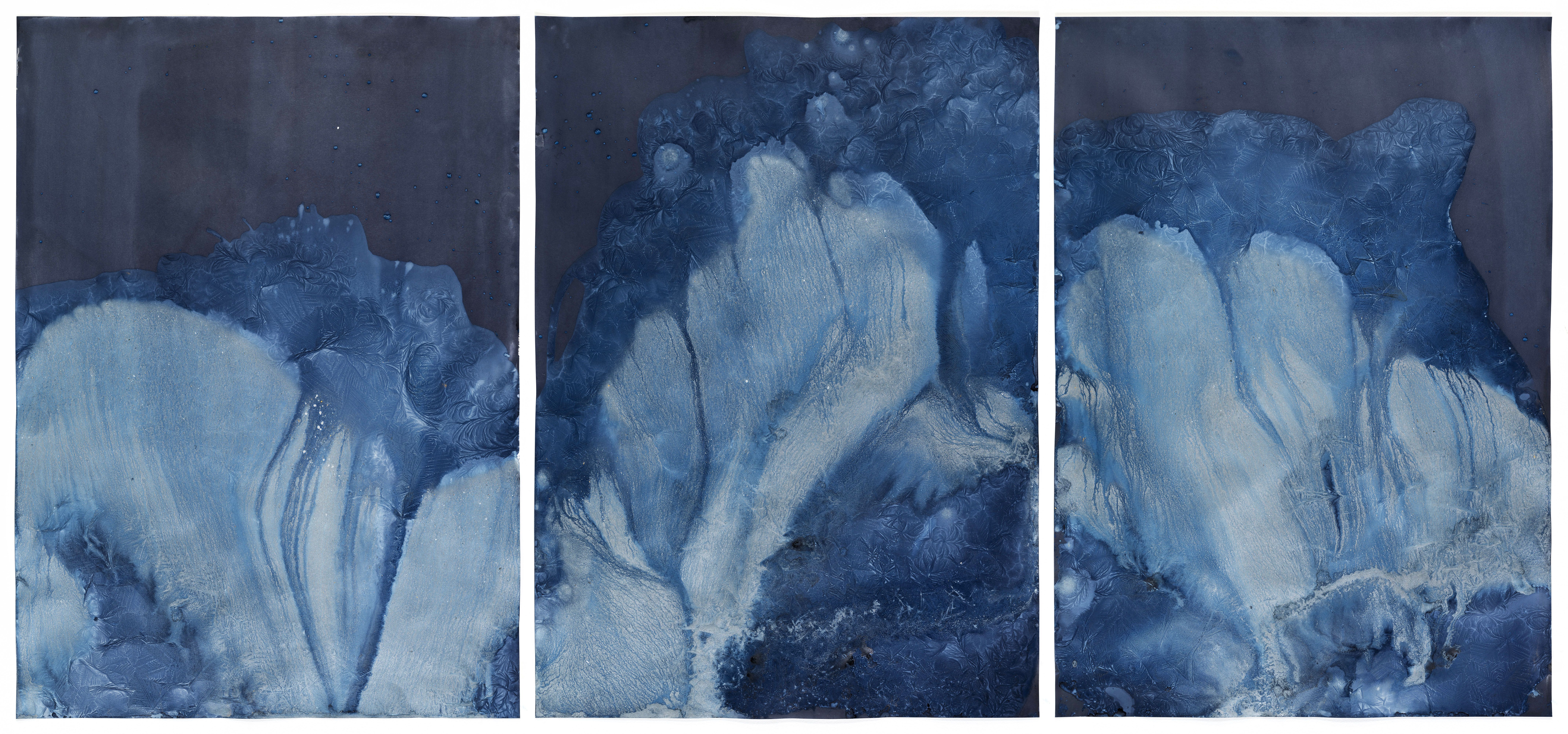
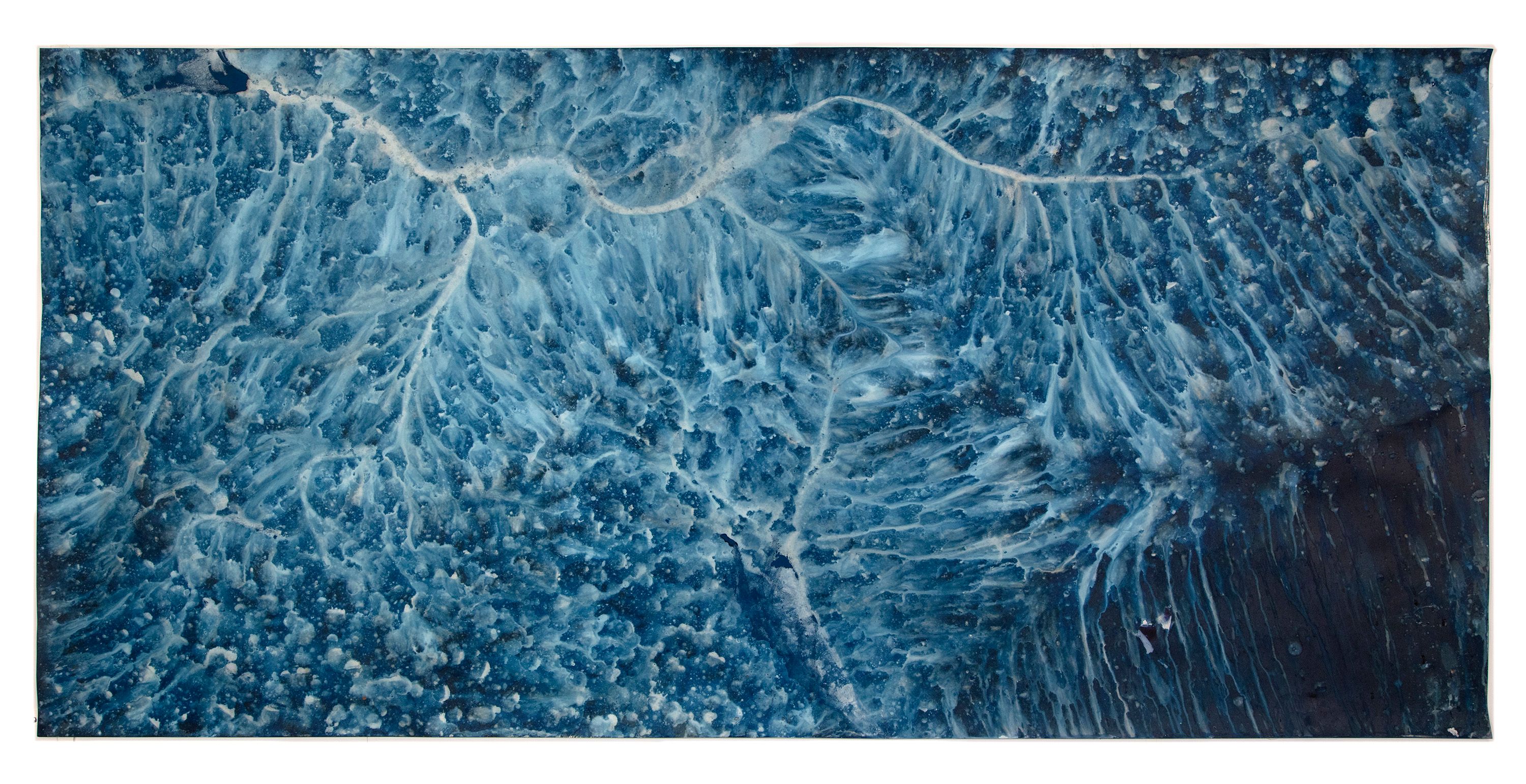
My process is intrinsically linked to the content of the work. I use large sheets of light-sensitive paper and bring them directly into the landscape, into the ocean, into rivers, into snow, and onto forest floors. The paper is exposed over time as water moves across its surface, as light shifts, and as elements like sand, debris, or ice leave their marks. So rather than composing an image through a lens, I’m engaging physically with environmental phenomena. The movement of waves, the behavior of water as it freezes, the presence of wind or sediment, these are the forces that shape the image. The work is about our complicated relationship with the natural world, and so the process itself becomes a kind of collaboration with that world. In fact, the physical nature of my work, where photography-based media come into contact with rain, waves, wind, and wintry environments, is a call to be in closer contact with our environment.
You place the work directly into unpredictable conditions. What does that uncertainty introduce into the process?
There’s a level of chaos that’s essential. I often work with large grids of paper, sometimes dozens of sheets joined together, and I might have a team helping me move them in and out of the water. But you can’t control the ocean. You can’t control the wind. Panels tear off, waves shift unexpectedly, people or animals pass through. It becomes an exercise in letting go. I’m not interested in controlling the landscape, I’m interested in asking it to show me its own mark-making. The images become, in a sense, conceptual drawings made by the environment itself.


In a time when image-making is largely defined by technological mediation, your work remains deeply committed to material processes and collaboration with the natural world. How do you think about authorship and mark-making in this context, particularly the relationship between your hand and the forces you work alongside?
My work often raises questions about authorship and collaboration: Who or what is making which marks? What did the wave do by chance? What was the result of my decisions? With my recent series State Shift, I increased the marks made by the human hand, adding to the compositions with materials such as minerals, mushroom ink, and gingko chlorophyll. Some prints also incorporate store-bought pigments, another nod to the presence of our current human moment in the work. My increased mark making is an allegory for the increased human impact on the landscape.
There’s a sense in your work of being grounded and expansive at the same time, like being on the earth and in the sky simultaneously. Do you feel that when you’re making the work?
Yes, though it happens in different ways. Sometimes the experience is very physical, holding onto a sheet of paper in strong wind, responding to immediate conditions. But at the same time, the exposure continues beyond my direct involvement. Even after the paper is out of my hands, light continues to act on it as it dries. That ongoing exposure, especially the way sunlight continues to transform the image, feels connected to something more expansive. There’s a moment where the work begins to become itself through the action of light, and that feels almost transcendent.
And that process never really ends, does it?
No, it doesn’t. The works continue to change over time. That’s part of what makes them collaborative, not just with the landscape during their making, but with time itself afterward.
Even once they’re in a collector’s home or a gallery, they’re still responsive to light. Some collectors intentionally hang them in sunlight to allow those changes to become more visible. For me, that ongoing transformation is central, it pushes back against the idea that a photograph should be fixed or permanent.
In State Shift, the presence of your body becomes increasingly visible through gesture, touch, movement, and even breath. What does this physical involvement allow you to access or express?
The creation of my recent series, State Shift, involved flinging paint, throwing ink at paper, pressing my hands onto the paper, using my breath to move liquid media, digging topographic forms to drape paper, painting with feathers, movements that arose from the internal binds of systemic participation, offering ways for me to attempt to shed the constraints on a body and life. Many pieces also incorporate fungi ink, resulting in prints that have regenerative, bioremediative properties. Ultimately the making becomes a way for me to re-root, reorient, bring connection between myself and the landscape, and bring myself home.
Beyond process and place, what are some of the larger ideas you’re exploring?
Interconnectivity is central. There’s a dominant narrative in our culture that we are separate, autonomous individuals. But when you look closely at natural systems, that idea begins to fall apart. I’ve been particularly interested in fungal networks, mycelial systems that connect entire ecosystems underground, exchanging nutrients and information. I sometimes incorporate inks made from mushrooms into my work, as a way of engaging directly with those systems. Even at the level of our own bodies, we are made up of vast networks of non-human organisms. Recognizing that interconnectedness shifts how we understand ourselves in relation to the world.
Place clearly plays a major role in your work. Can you talk about some of the locations you return to?
The Great Salt Lake is one place I return to frequently. It’s a fascinating and fragile ecosystem, especially as water levels continue to decline. As the lake recedes, exposed sediments can release toxins into the air, so the water itself becomes a kind of protective force. I also work at Mono Lake in California, which has its own complex history tied to resource extraction and environmental change. Each location carries its own set of conditions, both ecological and historical, and those conditions become embedded in the work.
A dialogue curated by Nigel Poor.
From a February 15, 2026 conversation presented by City Arts & Lectures, reproduced with permission.


