SHOT | Article Mary Sibande

Mary Sibande
Mary Sibande
0:00
--:--

Mary Sibande

The Fabric Of Freedom

Mary Sibande is a multidisciplinary artist from South Africa, who has dedicated much of her creative practice to unearthing her personal, as well as cultural history. Born and raised during the last decade of the apartheid era in South Africa, her creative practice was profoundly conditioned by the important historical changes she experienced first-hand in the years prior and following the segregation of black people on behalf of the country’s white minority government. Governed by the theme of colour and its emotional connotations, the artist’s works have travelled through phases and continue to explore the possibilities that colour offers as an expression of both racial and emotional meaning. Through her sculptures and photography, Mary Sibande has delved into the history of her own female forebearers to bring back to the surface images of a collective history of black female bodies that was previously buried beneath layers of discrimination, unfreedom and injustice. By weaving these threads together, she has brought these women’s lost perspectives, abandoned ambitions and forgotten narratives to the present, in a way that will be able to also inform the fabric of the future.

Mary Sibande Shot Magazine Interview Issue 14

Mary, how did your career as an artist begin and how has your environment conditioned your artwork? 

I studied at the university of Johannesburg, where I first decided to look into my personal history and understand why I am the first in my family to graduate from university. This led me to explore the history of South Africa, to see myself where I existed before my consciousness did: in this country, there were so many institutions created to limit the black body, such as slavery, colonialism, apartheid. So I imagined this body going through these phases and asked myself what it means to exist in times of freedom. This freedom was accomplished in the 1990s, when people of colour were finally allowed to vote. I remember being 11 years old, queuing with my grandmother for hours and hours, and sensing the excitement in the air: in my young age I picked up that this was an important moment. During apartheid, people didn’t talk about what was happening to black bodies in the fear that the more you knew, the more you’d get in trouble. For this reason I wanted to investigate this and my personal history. I didn’t think that this idea would become a concept I would carry within my works to this day.

Who is Sophie? How have these sculptures allowed you to engage in an exploration of your family, but particularly of your female continuum?

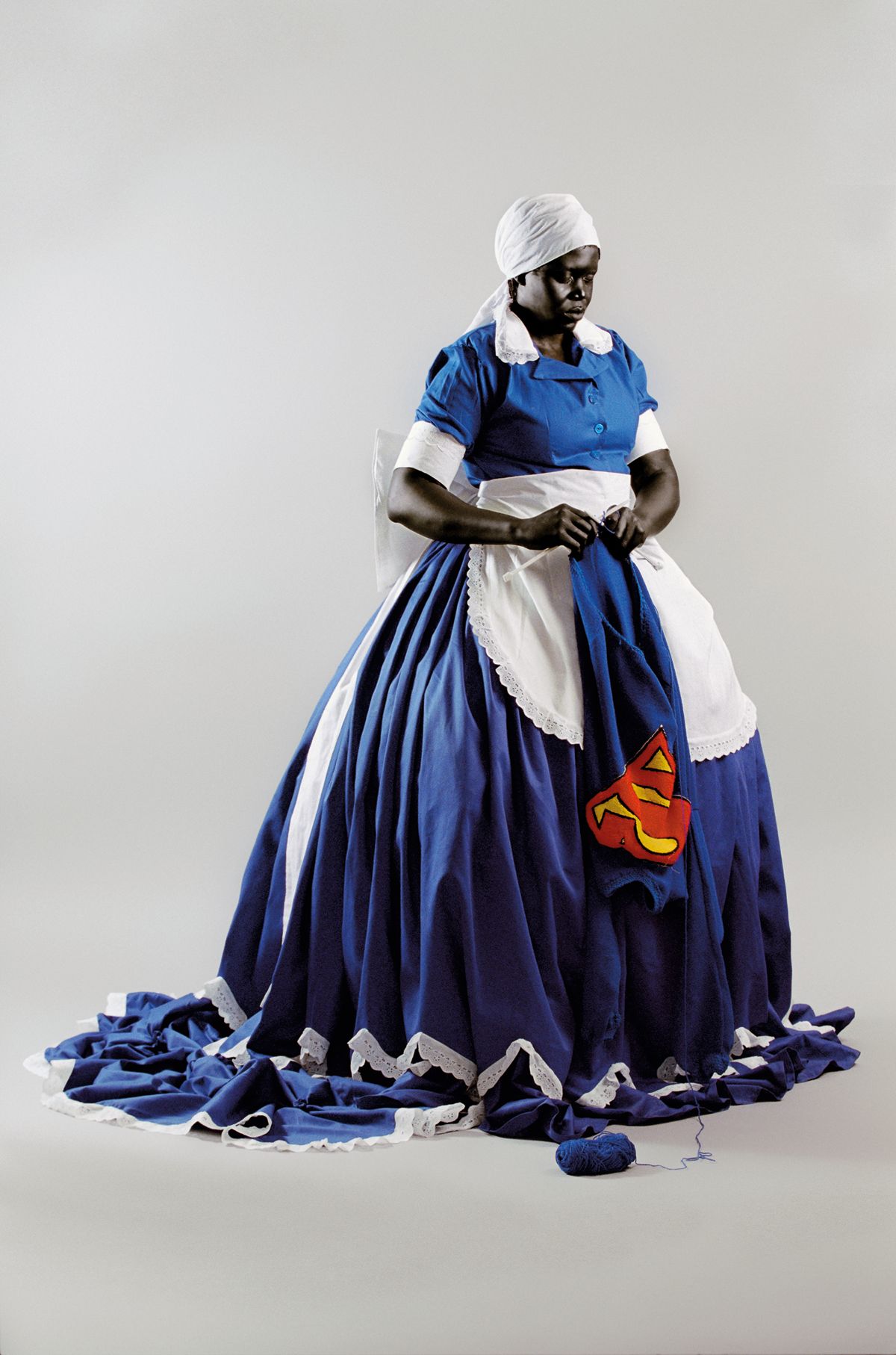
All the women in my family, as far as I can trace, were domestic workers. I created this avatar named Sophie, as in South Africa it was compulsory for a black child to have an African name and an English name, in order to show that one had converted to Christianity. This made me also look to my great grandmother, who was born in 1919 with two African names, but died with one African and one English name. This is why I created this avatar called Sophie, so I always have to be reminded of why I am calling her Sophie and why I am called Mary. I started to dress up as a domestic worker, posing in front of a camera and performing all the dreams my mother, grandmother and great-grandmother had: the main difference however was that I could choose to do this, unlike my forebearers who had no choice. They were limited both as black bodies and as women, so they were facing this double discrimination. I could never be these women although I am them, I come from them, I look like them. This process has allowed me to understand more not only about myself, but also about my people, where I come from and what it means to be black in South Africa, particularly under institutions that didn’t allow black people to be free.

The triad of colours employed in your works, seems to echo a multiplicity of perspectives, from the past towards the future, from immanence to transcendence.

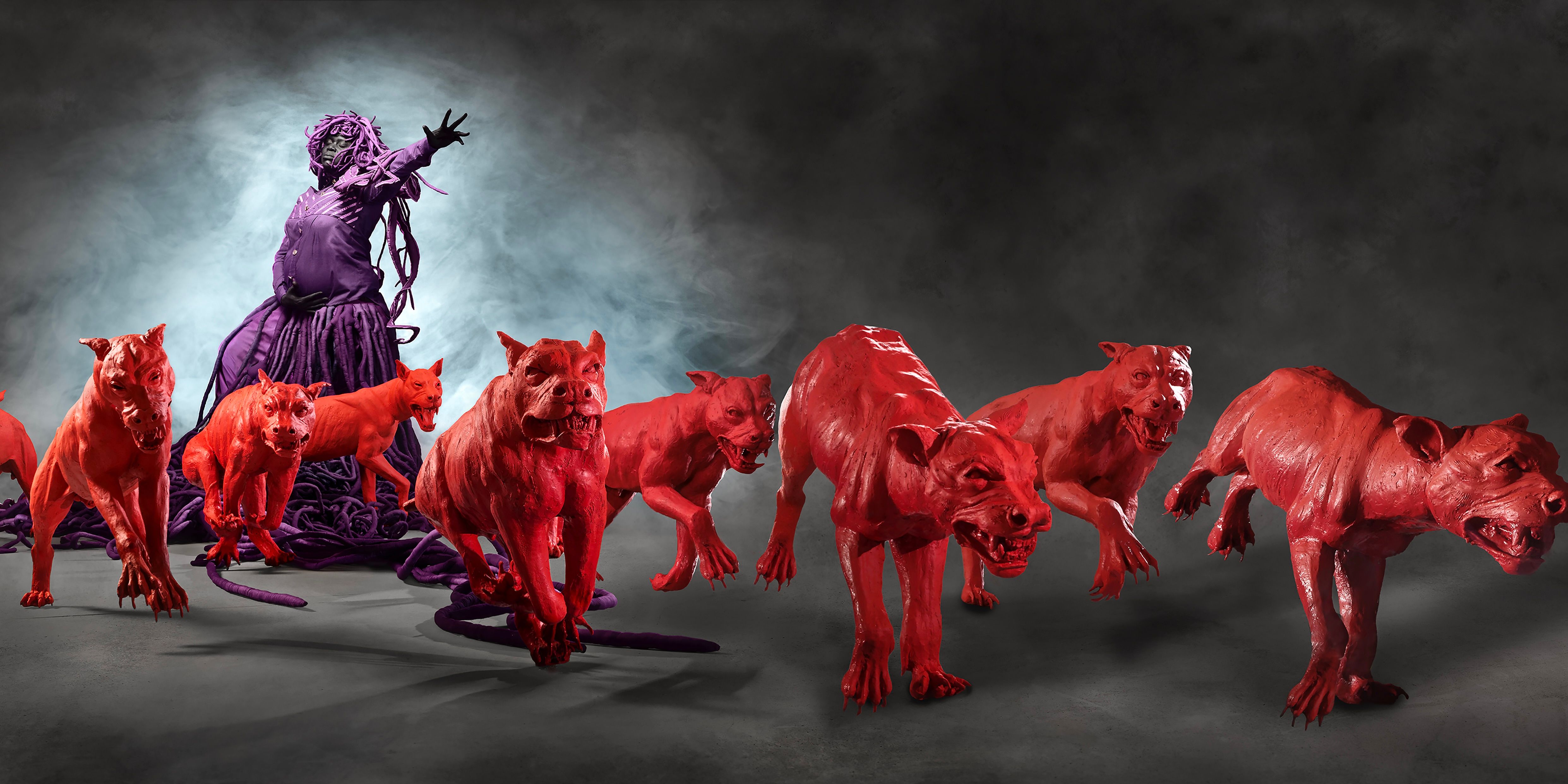
My work is separated into colours. Now that I actually have a trajectory of colours, I realise each colour had its own way of thinking: blue was about looking at the limitations of black women, particularly those in my family, and spoke about Bantu education in black communities, as a low form of knowledge to limit the educational potential of black people. The purple body of work looked more within, as a South African who is practicing and travelling the world, although women in my family could not afford to. Purple is about rebelling, looking inward, spreading as a horizon. Finally, red speaks of emotion and how crucial this is in human existence. In some way, I wanted to understand the psyche of my country: I feel like South Africa is an angry nation. Red was a way of understanding where this anger came from, almost like doing therapy. I wanted to highlight that this anger is boiling hot.
Mary Sibande Shot Magazine Interview Issue 14

Your works in red, in particular, seem to be touching a more sacred, or mythological realm. What is the role of spirituality in your works?

Around 2008, when I was starting with my first body of work, I was in my studio and there were three Zionist churches in the neighbourhood. In the context of South Africa, these are hybrid churches, that combine Christianity and traditional African beliefs in ancestors. These churches marry two worlds and create a new ideology of worship. The only aspect I looked at was that of fashion, how people dress and what colours they use. I buy my fabrics in the places these churches buy theirs. Hence I wanted to tap into this spiritual realm through this. If you look at my figures, their eyes are always closed, tapping into a world where only your thoughts exist, you are denying reality. You are looking inwards. My work has been about dreaming, but also about praying, manifesting, wishing. And this action has carried black bodies throughout history, in the desire to be free, to do something, to be healed.

Could you tell us some more about your creative process - what is the source and process in your works?

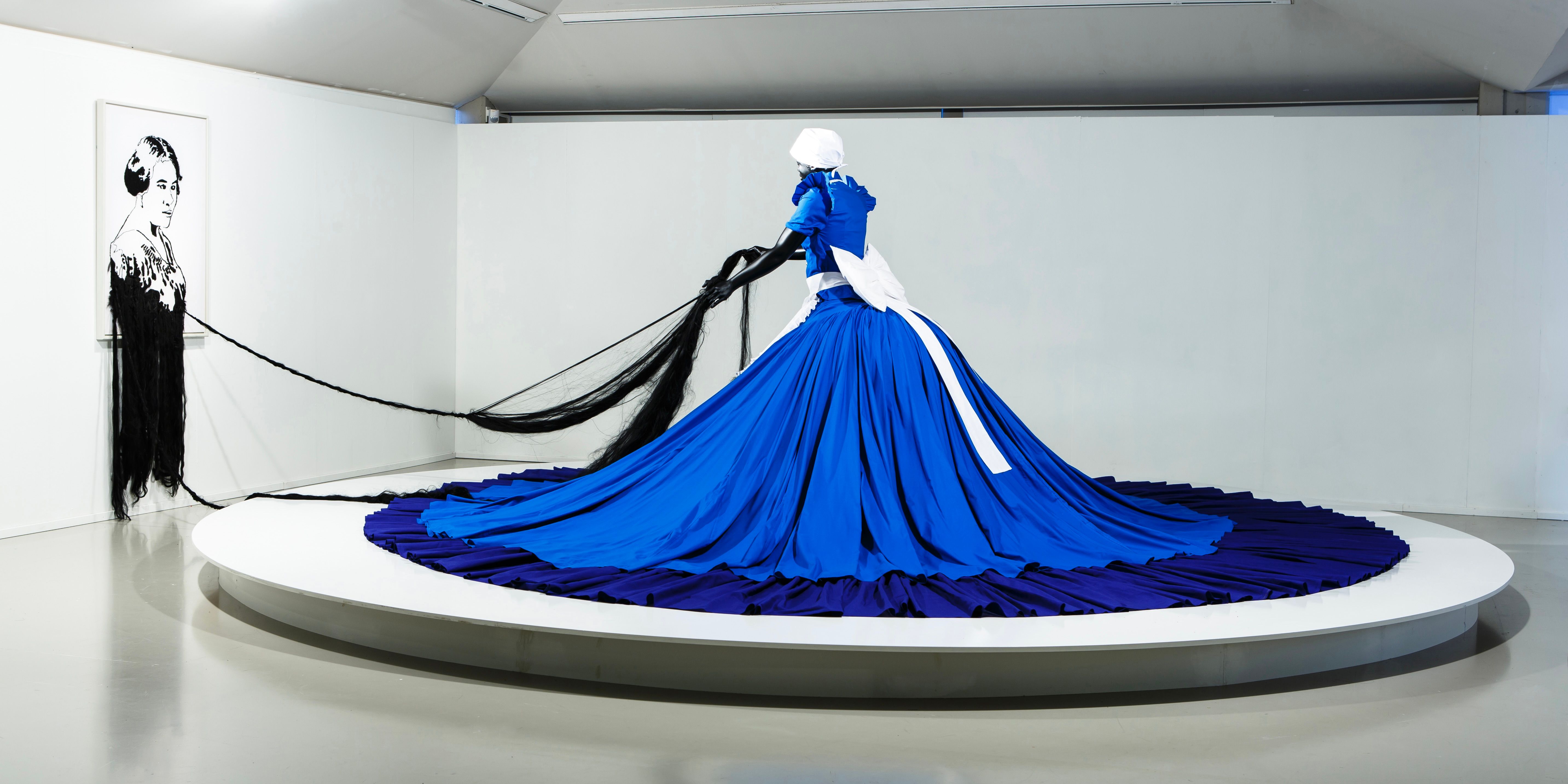
There are a few artists I take inspiration from. Noria Mabasa, for instance, will not create something unless she has dreamt it. The notion of dreaming has been a thread throughout my work. I also draw some inspiration from Tracey Rose, an all-rounded artist whose performances are challenging history and going against the odds. Yinka Shonibare has taught me much in terms of turning to colonialism and making work and speaking about it in a way that makes us understand ourselves. If we understand ourselves, we can also understand the future. In this sense, his work gave me the foundations for marrying fashion and fine art. Since then, I have been making dresses and turning fabric into an abstract object. It’s not about fabric anymore, but about manipulating that visual reference into something else, making it into roots. All these artists have formed me into the artist that I am today. 
Mary Sibande Shot Magazine Interview Issue 14

What is your greatest wish for these artworks in the future?

I hope to inspire a lot of women, a lot of women of colour. For me, it’s about inspiring the future, giving new artists a language to carry forward. I believe the past is always interconnected with the present, and the present is always interconnected with the future. For this reason I always like to bend time, going to the past and carrying it into the present to inspire the future. But the future is always imagined, because nobody knows what it will look like. Yet it is filled with lots of possibilities.

What is next for you, artistically?

After red, after anger, I am thinking of the colour that comes next: the colour yellow, as a symbol of calming down, resting, appeasing. In particular, I am thinking of exploring Desmond Tutu’s concept of the ‘Rainbow Nation’, a term which he coined to describe post-apartheid South Africa. He used this to refer to the multiplicity of cultures, and colours, that are finally learning to live with each other after a difficult past. I thus intend to incorporate this into my future works to explore how the Rainbow Nation can help us find peace, coexistence and freedom.

What is womanhood, to you? 

Womanhood has highly inspired my artwork. The question of being a woman, for me, cannot be separated from the question of being a black woman. Being a woman is about learning from the past, about bringing all the women who existed before me to the foreground. However, it is also about exploring what it means to be a woman as an individual human being. It is a communal thing, related to gathering, belonging to a village, having the power to give birth and bring life into the world.

More interesting

Mary Mattingly Shot Magazine Interview Issue 13

Mary Mattingly

As our environment is becoming more and more tainted with the remnantsof our consumption, it is essential to take a step back to reconsider how we engage with the objects we possess, remembering the journey that not only precedes them, but also will follow once they are outwith our control. Do objects come with responsibility? This is the question which defines our relationship with the material world and lingers behind the artistic devotion of Mary Mattingly, a visual artist based in Brooklyn, NYC. Her works range through photography, collaborative sculpture, performance and land art, expressed in some of her collective projects such as Swale, an edible landscape floating on a barge in New York for fresh food foraging; Public Water, a public artwork and campaign on the city’s water supply chain; or the Waterpod Project, exploring the possibility of nomadic and mobile water-communities. The building of these independent living systems repre-sents a need to reimagine the ways we will live together as a community in the present and future. Along with these urban ‘ecosystems’, Mattingly has also thoroughly explored the themes of sustainability, possession and waste, tracing the maps which underlie the life of objects that surround us every day. Through her series ‘Nomadographies and Wearable Homes’ and ‘House and Universe’, she was able to capture the nature of humankind as a constituent part of the environment, constantly roaming and transforming with it. Through the contrast of local and non-local spaces, whose interdependency is ever so evident in supply and waste chains, Mattingly presents an allegorical collection of photographs embracing the connection between climate disasters and consumption. In 2013, she decided to bundle almost all of the objects she possessed in seven large bundles which were pushed or rolled through the streets of New York. Afterwards, she began a digital archive of all these objects, emphasising their history before parting with them: from their extraction from the earth, to their journey into the hands of makers and distributors, to the impact of chemicals dispersed in the air and water. In her own words, each object is embedded with trauma. Though this practice, she wished to shed light not only on the weight that reduces our mobility, but also on the material relationships within the objects themselves and their impact on others. In her photographs, it becomes clear how the answer to the question is yes: we are responsible for our waste of time and the Sisyphean burden of objects we collect throughout our lives, but we are also able to take the lead and cultivate our lightness.

Odile Decq Shot Magazine Interview Issue 14 Architecture

Odile Decq

By taking the discipline of architecture to its creative extremes, Odile Decq is renowned for her whimsical and cutting-edge projects that attempt to reimagine space and what is possible to create within this. As an architect, urban planner and academic, Odile Decq merges her bold creative language with the surrounding environment to create buildings that radically reconceptualise the relationships between human life and space. Particularly in the male dominated field of architecture, she has broken boundaries both due to her creative intuition and her struggle as a woman in this environment, thus proving to the younger generation that daring to dream is, indeed, the only way to change reality for the better. In this interview, we have the pleasure of speaking to the founder of Studio Odile Decq.

Sepideh Salehi Shot Magazine Interview Issue 14

Sepideh Salehi

As a brave, bold and elegant artist, Sepideh Salehi has been merging various visual languages and processes to explore the notions of home, family and cultural history. Born in Teheran, Iran, Sepideh’s artwork is profoundly soaked in her experience as a young Iranian woman during the authoritarian regime of the Islamic state, which has institutionalised the segregation of women and men, to this day, in what is now known as gender apartheid. The concepts of covering up, hiding and privacy have thus underpinned the layers of collage, photography, painting, printmaking, calligraphy that the artist has combined to explore the relationship between the inner and outer vision of female identity. As well as this, Sepideh is interested in exploring how one’s environment, memories, belonging may be intertwined with their personal narratives to reimagine realities and propose new visions. In the obscured faces of her photographic collages, such as the iconic Mohr Portrait, the connection between identity, landscape and unknown is dissected and reconfigured to understand how women are wrongly perceived in their society and to question how the female self-perception is conditioned by its environment. As a sign of protest, her faces are covered, unrevealed, obscured from the viewer to allow for their identity to mature in secret. For this reason, Sepideh merges post-1979 Teheran cultural history with elements of her own past, in order to depict the struggles of female oppression against the injustice of abusive political regime, and to bring together a new, unknown gaze beneath the layers of one’s identity.

Hanan Roz Shot Magazine Interview Issue 14 Firetti Contemporary

Hanan Roz

With the delicate and elegant silhouettes of these bodies, fluctuating as ghosts in cages of wire mesh, the expectations that are constantly put on women’s bodies are challenged in a radical yet subtle manner. Hanan Roz, the Lebanese artist and creator of this collection of sculptures, here explores the hidden dichotomies of toughness and fragility, beauty and pain, expectations and reality, both in their material and symbolic forms. By incorporating her personal experience as a woman into the process of creating these delicate yet arduous bodies, she explores the meaning of femininity and beauty, thus offering the viewer a sense of this journey. Hands are reaching out from skins made of wire, whilst headless and limbless bodies sensually dance within their invisible nets. Each sculpture incarnates a diverse expression of the feminine body, shedding light on its metaphysical structures, its innate diversity, its beautiful strength.

Anastasiia Koval Shot Magazine Interview Issue 14  Photography Fashion Model New York

Anastasiia Koval

Born in Ukraine, Koval embraced a career as a model at a very young age before moving to New York City. Surrounded by the style and personalities of her fellow models, Koval began to photograph them as they were drinking wine, smoking cigarettes or choosing their outfits. In this way, her passion for photography naturally emerged as she began capturing stolen moments and natural settings, allowing her to express herself through this creative practice. This is how her art project began, As I See You by Koval.

Maïmouna Guerresi Shot Magazine Interview Issue 14

Maïmouna Guerresi

In her works, the Italian-Senegalese artist Maïmouna Guerresi portrays the sacred nature of humanity by merging influences from her own personal ancestry and a plurality of cultures. Particularly inspired by Islam and Sufi mysticism, Maïmouna draws from these philosophies to represent messages that are universal in nature, as they appeal to human spirituality devoid of any particular localism, through bare backgrounds, giant figures and plain robes. With simple beauty, she delves into the realm of religion and mystique accompanied by an elegant and graceful language which she developed throughout her artistic development in the Veneto region of Italy. In her works, Maïmouna elevates the human condition to one of spiritual being, of symbolic meaning, of profound understanding.

Aleah Chapin Shot Magazine Interview Issue 14

Aleah Chapin

Aleah Chapin is a visual artist from Seattle, USA, who has been painting human bodies to question, reconsider, reimagine and subvert their traditional role in western culture. Female bodies in particular are portrayed as they are dancing, laughing, interfolding, embracing each other, to explore the notions of aging, gender and beauty as we see them genuinely unfold before our eye, balanced within a misty landscape, against the backdrop of a forest or amongst dragonflies. Aleah’s early paintings depict natural bodies that recount their own stories, that become expressions of the forces of life, as opposed to the values through which we are taught to understand them in our contemporary society. Her most recent works stand in stark contrast with the immaculate realism of the previous, representing a radical shift inwards to a more abstract, emotional, psychological dimension. This conceptual understanding of living within a body, of finding a way home to ourselves, was prompted by the turbulent times that have shaken our world in the last years, thus leading the artist to seek for greater meaning in a visual language that relies on colours, shapes and feelings, putting forth a more comprehensive and universal message. Nonetheless, throughout her works, Aleah Chapin consistently invites new conversations on the same question: what does it mean to exist within a body today?

© 2026 SHOT. All rights reserved.

Terms of UsePrivacy PolicyCookie Policy

© 2026 SHOT. All rights reserved.

Terms of UsePrivacy PolicyCookie Policy