SHOT | Article Maïmouna Guerresi

Maïmouna Guerresi
Maïmouna Guerresi Shot Magazine Interview Issue 14
0:00
--:--

Maïmouna Guerresi

Between Spirit and Earth

In her works, the Italian-Senegalese artist Maïmouna Guerresi portrays the sacred nature of humanity by merging influences from her own personal ancestry and a plurality of cultures. Particularly inspired by Islam and Sufi mysticism, Maïmouna draws from these philosophies to represent messages that are universal in nature, as they appeal to human spirituality devoid of any particular localism, through bare backgrounds, giant figures and plain robes. With simple beauty, she delves into the realm of religion and mystique accompanied by an elegant and graceful language which she developed throughout her artistic development in the Veneto region of Italy. In her works, Maïmouna elevates the human condition to one of spiritual being, of symbolic meaning, of profound understanding.

Maïmouna Guerresi Shot Magazine Interview Issue 14

Maïmouna, thank you for sharing your thoughts and journey as an artist with Shot Magazine. First of all, as an Italian-Senegalese artist, where feels most like home to you?

Home is where I create my works. This creative process takes form both in Senegal and Italy. Senegal is the land where I gather all my energy, it is the land that stimulates my photographic and sculpture works. These works are conceived and produced there, and sometimes I conclude them in my studio in the Veneto region in Italy. Senegal is the place of my spiritual retreat, and is a great stimulus for my creative expression. I take many of my photographs on the terrace of the family house in Dakar, playing with natural light and painting the walls that serve as a backdrop for the characters I portray. I employ the same method in my studio in Veneto when I prepare the backdrops for the photographs.

What prompted you to start a career as a photographer and artist?

My artistic career, in some ways, was born within my family in Veneto. When I was young, my parents used to hostAfrican priests, who were colleagues of my uncle, a missionary in Africa. At home, we used to look at photographs and videos taken by the clergymen, and this first approach to photography was fundamental for my artistic visual training. Later I studied at the art school and then at the academy of fine arts in Venice. After a short period of painting and graphicdesign I chose my photographic language. My first works were inserted in the artistic context of body art, where I compared my body with nature, with trees and with the mythical characters of Daphne and Apollo. In this context, in conjunction with the sculptural casts intended as "armor-chrysalis", my first black and white photographs, entitled "Mimesis" were created. Afterwards, I worked combining sculpture and photography.
Maïmouna Guerresi Shot Magazine Interview Issue 14

What is the relationship between art and Islam, in your creative process?

For me, Islam is knowledge and inner strength. It is a continuous source of inspiration for my art and I cannot separate my most intimate thoughts and my life from my artistic expression. Through my work I intend to interpret the different aspects related to Muslim spirituality with its many cultural facets and its syncretisms. My vision of art is to be able to express my sensibility, my emotions and my profoundly Islamic thoughts, through an artistic language that makes use of different expressive techniques, from video to sculpture to installation to photography. My desire is to propose a language where form and content are combined with ethics and compositional beauty. In the set of my works, I often insert calligraphic elements composed of symbols, names and invocations to intensify the cultural context in which the work is created. This, for instance, can be seen in the photographic polyptych "Students & Teacher". The photographic composition of several panels summarizes the concept of union in fragmentation. The characters, separated in each panel, are united by a single backdrop and a long table creating a metaphysical scene suspended in time. On the backdrop placed in three quarters of the composition I painted the Basmala calligraphy with which all the suras of the Koran open "In the name of God the clement and the merciful''. The calligraphy declares the cryptic meaning of the golden proportion and therefore of the perfect Divine balance.

The figures in your portraits are often draped with cloaks, yet hollowed out, illusory, levitating. What is the meaning of their emptiness?

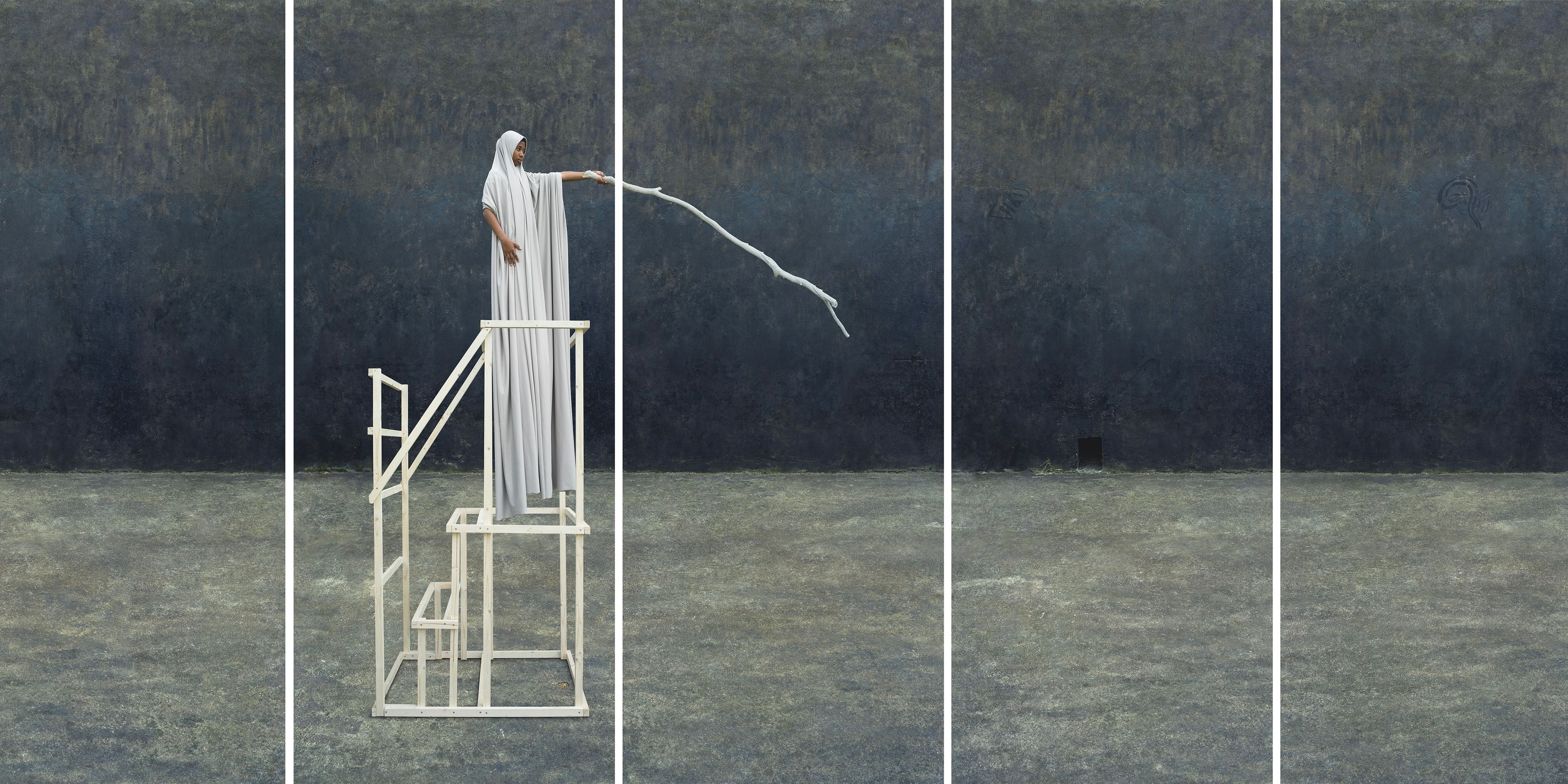
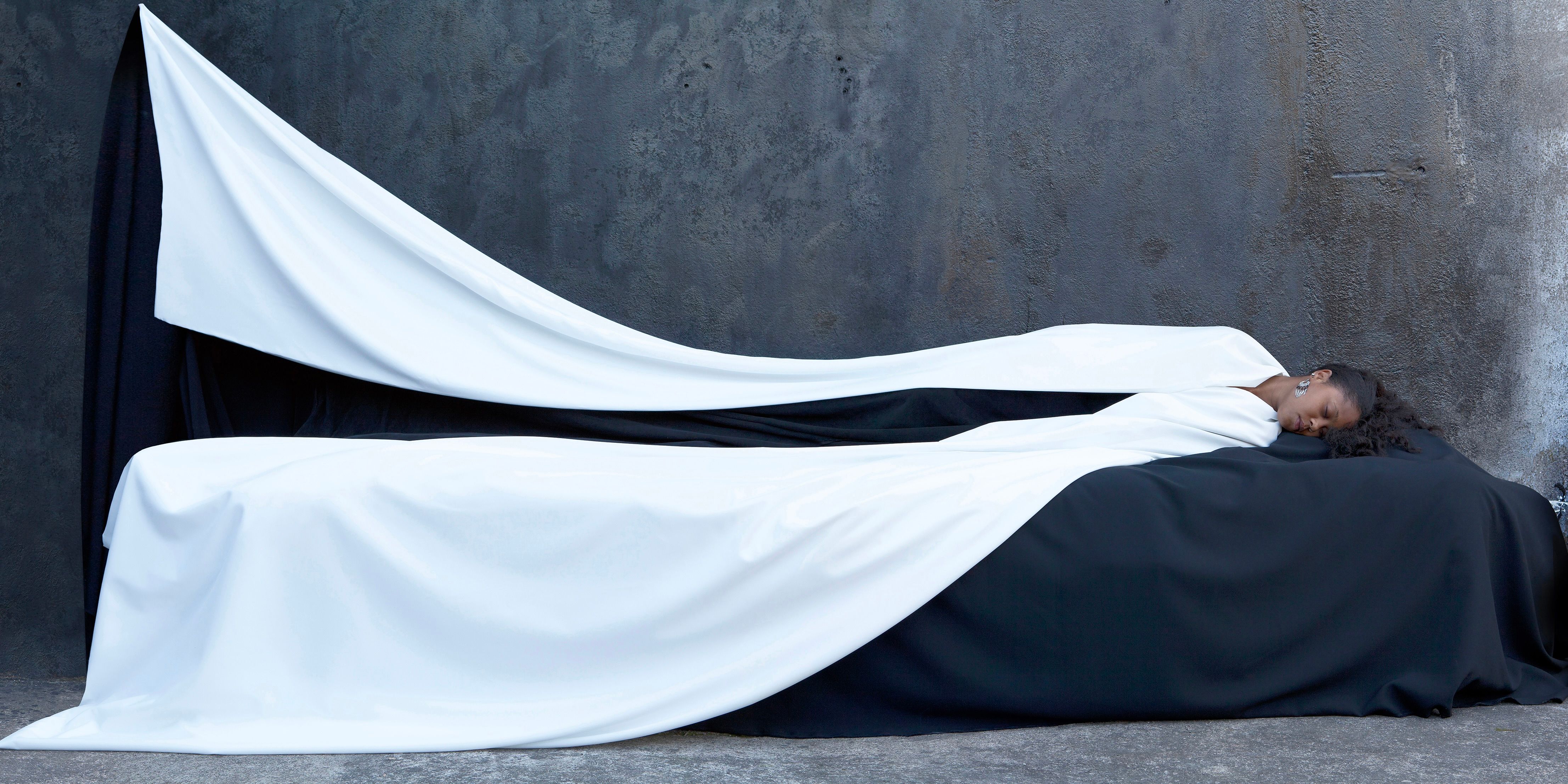
For these figures I was inspired by the mystical Sufi characters I had the honor of meeting during visits to the holy places of Islam. I didn't want to represent their physiognomy but rather their spiritual greatness in a giant and spatial dimension, like so many unknown worlds and universes. An allegory of the ancestral spirits deriving from the biblical progenitor Adam, which in Arab and African mythology acquire gigantic proportions. The cloak they wear suggests that they possess tangible bodies, but that it is filled with a dark and mysterious void, a dimensionless and timeless space filled with vibrant quantum energy. This unfamiliar space is scary, but it's also mysteriously attractive.

What is the role of your femininity, and the femininity of your characters, in your works?

With my work I seek to reaffirm a universally recognizable feminine energy and decolonize the various stereotypical ideas of women in the Islamic world. Through symbols, names, video performances, photographs and artifacts, I try to shed light on the mystical Muslim female personalities, particularly African, who have contributed to the social and spiritual evolution of their country but have been forgotten by history.
Maïmouna Guerresi Shot Magazine Interview Issue 14

Some of your portraits incorporate not only spiritual, but also environmental elements such as branches, leaves, landscapes. What is the role of these symbols? How do you envision the notion of nature in your artwork?

Since my first photographic works I have been looking for an intimate dialogue with the “divine” by affirming the importance of natural elements, such as the symbolism of the tree or the branch, which become a metaphysical bridge between heaven and earth. In my photographic series, many of the characters are in dialogue with nature, and in particular with the symbology of the Touba tree. A sacred tree mentioned several times in Muslim writings and recognized as a living and regenerative entity. The holy city of Senegal bears the same name. In the photograph Yaye-Fall, (“Yaye” means “Mother” in Wolof), I create a dialogue between the feminine spiritual strength and the symbolism of the Touba tree. I portray Yaye-Fall as a gigantic figure wearing a large cloak made up of many pieces of cloth, a characteristic costume of the Sufi Muslim community of the Muride Baye Fall.

The figure coalesces with the Baobab, a common plant in Senegal. Beneath her mantle, roots emerge and penetrate the sand. This relation underlines her connection with her land, through her strong cultural and spiritual roots. In other works, such as the photographic installation Beyond the Border shown a the "Passport" exhibition at the African Foundation in Lagos, Nigeria, I represent the idea of transition, cultural and spiritual belonging using autobiographical references. The installation is made up of photographic diptychs with images of double passports that become a metaphor for a double identity. This metaphor is further illustrated in the images of the diptychs, in which the same specular character offers branches to herself. An exchange where nature becomes the medium for an energy connection and the search for a new dimension and social evolution.

How does your spirituality shape your sense of self, as a woman and artist?

Spirituality but also politics, understood as ethics and social life, is part of all my artistic creation. Sufi philosophical, scientific and spiritual thought, sacred texts and poems have helped my spiritual formation as a human being and as a woman. Sufism is my dwelling, my compass for continuous spiritual growth. I think it is necessary for one's existence to make an effort to seek an inner elevation. Among my artistic research, I have discovered that many female Sufi mystic poets were protagonists of the birth and growth of Sufism. This confirms that women in Islam have had a great spiritual and social role. This research has helped me as a Muslim-Woman-Artist to overcome many stereotypes created by an arrogant Western vision of civilization.

What is womanhood, to you?

Femininity is a term that I consider a broad, intense, forgiving and merciful quality, which does not refer only to the female gender. The terms “feminine” and “masculine” are characters essentially constructed and acted out through a process of social construction. The female characters in my works are the protagonists of a rooted and regenerative spiritual nature that goes beyond all geographical and gender boundaries, for me it is a way of communicating an evolved vision of the human being.

All images courtesy of the artist and Marine Ibrahim Gallery

More interesting

Cristina Mittermeier Shot Magazine Interview Issue 14

Cristina Mittermeier

The dusky pink trio of feeding flamingos, the ethereal vision of a lonely humpback whale or the current of a colourful shoal of fish are only some of the rich collection of photographs that Cristina “Mitty” Mittermeier has caught and brought back to land from the depths of the natural world. With her talent and profound ecological sensibility, Cristina has become one of the leading nature photographer of our day and has co-founded SeaLegacy, a global agency for the ocean aiming to bring together climate action and sustainable solutions by supporting scientific endeavours and conservation strategies. In her explorations of both the natural and human realms, Cristina attempts to bridge these worlds through her photography, in an attempt to instil awe and convey the beauty of ecologies that are often distant and unseen. In this interview, she tells us about how her relationship to the natural environment has developed, how her journey as a woman has affected her works, and how we must understand how much is enough in order to find harmony with our wounded and depleted earth. It all starts with a sense of enough.

Hanan Roz Shot Magazine Interview Issue 14 Firetti Contemporary

Hanan Roz

With the delicate and elegant silhouettes of these bodies, fluctuating as ghosts in cages of wire mesh, the expectations that are constantly put on women’s bodies are challenged in a radical yet subtle manner. Hanan Roz, the Lebanese artist and creator of this collection of sculptures, here explores the hidden dichotomies of toughness and fragility, beauty and pain, expectations and reality, both in their material and symbolic forms. By incorporating her personal experience as a woman into the process of creating these delicate yet arduous bodies, she explores the meaning of femininity and beauty, thus offering the viewer a sense of this journey. Hands are reaching out from skins made of wire, whilst headless and limbless bodies sensually dance within their invisible nets. Each sculpture incarnates a diverse expression of the feminine body, shedding light on its metaphysical structures, its innate diversity, its beautiful strength.

Anastasiia Koval Shot Magazine Interview Issue 14  Photography Fashion Model New York

Anastasiia Koval

Born in Ukraine, Koval embraced a career as a model at a very young age before moving to New York City. Surrounded by the style and personalities of her fellow models, Koval began to photograph them as they were drinking wine, smoking cigarettes or choosing their outfits. In this way, her passion for photography naturally emerged as she began capturing stolen moments and natural settings, allowing her to express herself through this creative practice. This is how her art project began, As I See You by Koval.

Aleah Chapin Shot Magazine Interview Issue 14

Aleah Chapin

Aleah Chapin is a visual artist from Seattle, USA, who has been painting human bodies to question, reconsider, reimagine and subvert their traditional role in western culture. Female bodies in particular are portrayed as they are dancing, laughing, interfolding, embracing each other, to explore the notions of aging, gender and beauty as we see them genuinely unfold before our eye, balanced within a misty landscape, against the backdrop of a forest or amongst dragonflies. Aleah’s early paintings depict natural bodies that recount their own stories, that become expressions of the forces of life, as opposed to the values through which we are taught to understand them in our contemporary society. Her most recent works stand in stark contrast with the immaculate realism of the previous, representing a radical shift inwards to a more abstract, emotional, psychological dimension. This conceptual understanding of living within a body, of finding a way home to ourselves, was prompted by the turbulent times that have shaken our world in the last years, thus leading the artist to seek for greater meaning in a visual language that relies on colours, shapes and feelings, putting forth a more comprehensive and universal message. Nonetheless, throughout her works, Aleah Chapin consistently invites new conversations on the same question: what does it mean to exist within a body today?

Mary Mattingly Shot Magazine Interview Issue 13

Mary Mattingly

As our environment is becoming more and more tainted with the remnantsof our consumption, it is essential to take a step back to reconsider how we engage with the objects we possess, remembering the journey that not only precedes them, but also will follow once they are outwith our control. Do objects come with responsibility? This is the question which defines our relationship with the material world and lingers behind the artistic devotion of Mary Mattingly, a visual artist based in Brooklyn, NYC. Her works range through photography, collaborative sculpture, performance and land art, expressed in some of her collective projects such as Swale, an edible landscape floating on a barge in New York for fresh food foraging; Public Water, a public artwork and campaign on the city’s water supply chain; or the Waterpod Project, exploring the possibility of nomadic and mobile water-communities. The building of these independent living systems repre-sents a need to reimagine the ways we will live together as a community in the present and future. Along with these urban ‘ecosystems’, Mattingly has also thoroughly explored the themes of sustainability, possession and waste, tracing the maps which underlie the life of objects that surround us every day. Through her series ‘Nomadographies and Wearable Homes’ and ‘House and Universe’, she was able to capture the nature of humankind as a constituent part of the environment, constantly roaming and transforming with it. Through the contrast of local and non-local spaces, whose interdependency is ever so evident in supply and waste chains, Mattingly presents an allegorical collection of photographs embracing the connection between climate disasters and consumption. In 2013, she decided to bundle almost all of the objects she possessed in seven large bundles which were pushed or rolled through the streets of New York. Afterwards, she began a digital archive of all these objects, emphasising their history before parting with them: from their extraction from the earth, to their journey into the hands of makers and distributors, to the impact of chemicals dispersed in the air and water. In her own words, each object is embedded with trauma. Though this practice, she wished to shed light not only on the weight that reduces our mobility, but also on the material relationships within the objects themselves and their impact on others. In her photographs, it becomes clear how the answer to the question is yes: we are responsible for our waste of time and the Sisyphean burden of objects we collect throughout our lives, but we are also able to take the lead and cultivate our lightness.

Sepideh Salehi Shot Magazine Interview Issue 14

Sepideh Salehi

As a brave, bold and elegant artist, Sepideh Salehi has been merging various visual languages and processes to explore the notions of home, family and cultural history. Born in Teheran, Iran, Sepideh’s artwork is profoundly soaked in her experience as a young Iranian woman during the authoritarian regime of the Islamic state, which has institutionalised the segregation of women and men, to this day, in what is now known as gender apartheid. The concepts of covering up, hiding and privacy have thus underpinned the layers of collage, photography, painting, printmaking, calligraphy that the artist has combined to explore the relationship between the inner and outer vision of female identity. As well as this, Sepideh is interested in exploring how one’s environment, memories, belonging may be intertwined with their personal narratives to reimagine realities and propose new visions. In the obscured faces of her photographic collages, such as the iconic Mohr Portrait, the connection between identity, landscape and unknown is dissected and reconfigured to understand how women are wrongly perceived in their society and to question how the female self-perception is conditioned by its environment. As a sign of protest, her faces are covered, unrevealed, obscured from the viewer to allow for their identity to mature in secret. For this reason, Sepideh merges post-1979 Teheran cultural history with elements of her own past, in order to depict the struggles of female oppression against the injustice of abusive political regime, and to bring together a new, unknown gaze beneath the layers of one’s identity.

Odile Decq Shot Magazine Interview Issue 14 Architecture

Odile Decq

By taking the discipline of architecture to its creative extremes, Odile Decq is renowned for her whimsical and cutting-edge projects that attempt to reimagine space and what is possible to create within this. As an architect, urban planner and academic, Odile Decq merges her bold creative language with the surrounding environment to create buildings that radically reconceptualise the relationships between human life and space. Particularly in the male dominated field of architecture, she has broken boundaries both due to her creative intuition and her struggle as a woman in this environment, thus proving to the younger generation that daring to dream is, indeed, the only way to change reality for the better. In this interview, we have the pleasure of speaking to the founder of Studio Odile Decq.

© 2026 SHOT. All rights reserved.

Terms of UsePrivacy PolicyCookie Policy

© 2026 SHOT. All rights reserved.

Terms of UsePrivacy PolicyCookie Policy