Fabienne Verdier does not paint forms. She paints forces. Gravity, weight, speed, resistance: every element enters the gesture and takes part in the birth of the work. Her monumental brushes, suspended in space, transform painting into a physical act, where the body does not simply control matter, but moves through it, guides it, and allows it to react. Each mark is born from a tension between intention and the unforeseen, between discipline and the loss of control. The result does not imitate nature: it uses its weight, its pull, its movement. In a time that seeks perfect, reproducible images, Verdier brings painting back to its most human point: an unrepeatable, living, necessary gesture.

SHOT 17 is titled Made by Humans. In a world increasingly shaped by algorithms and artificial intelligence, what does being an artist mean to you today?
That’s an interesting question. Being an artist today, in the age of algorithms, is quite a challenge! Perhaps being an artist means reaffirming the value of the embodied experience: risk, intuition, physical presence and lived time. AI excels at correlating, but not yet at experiencing. My work celebrates the irregularity of gesture, the accident and the imprint of breath: everything that, in a way, eludes prediction. The artist becomes a counterpoint, a place where the sensory and the ambiguous persist, where we create not answers, but sensations.
Your decision to leave France for China came from a deeper existential question: how to paint life itself, movement, spontaneity, constant transformation. You felt the Western academic system was too rigid to express that living reality. How did China transform not only your artistic language, but your entire perception of reality?
In China, I discovered a philosophy centred on flow rather than the finished form. I was taught an aesthetic that was radically different from our Western concepts. SI encountered the principles of fullness and emptiness, the practice of calligraphy as a fluid form of writing, like breath, and impermanence as a cardinal principle. This shifted my language away from representation and towards allowing things to emerge. In Chinese, Korean or Japanese paintings the individual was no longer at the centre or in the foreground of the canvas, but rather blended into nature and the living world around them. My perception of reality has broadened: fewer objects, more relationships, but also fewer contours and ultimately more flow. The world is no longer a scene to be painted, but a current in which I sail, I capture, I paint.
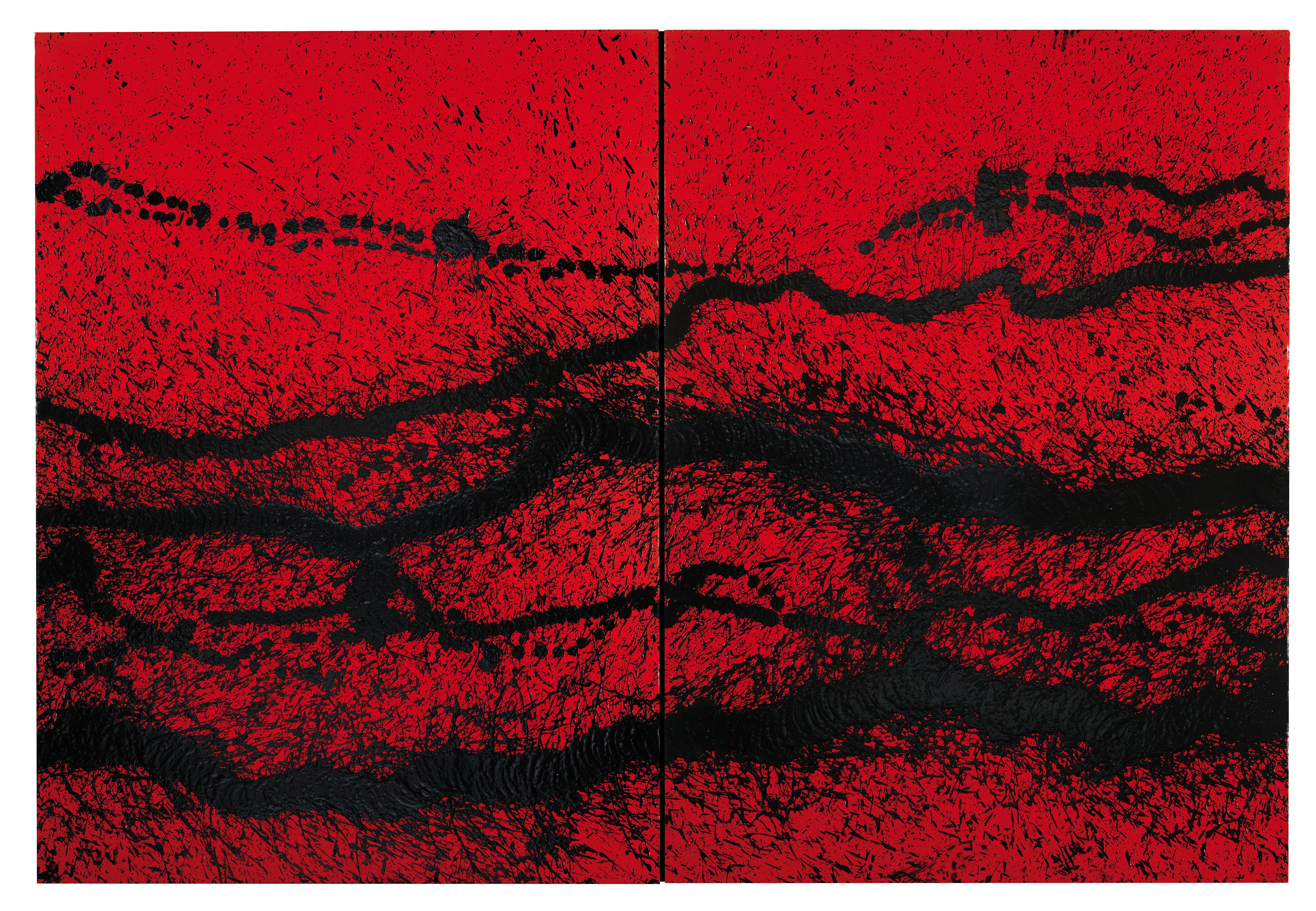
In your vertical painting practice, gravity becomes part of the gesture itself, allowing the brushstroke to escape complete control. What interests you about that space between intention and unpredictability?
This interval is the living heart of the work. Intention provides the impetus. I spend long hours thinking about the form before picking up my brushes. I am interested in the forces that underpin shapes, and mental preparation is essential, but paradoxically it is also the unpredictable that brings in the truth of reality. Gravity, capillary action, and the flow of paint write what I do not yet know. I find an ethical dimension in this: humbly accepting that I cannot control everything, embracing otherness, change, and the metamorphoses of matter, which open up new horizons to be discovered, and learning to co-create with matter itself.
Your monumental suspended brushes transform painting into an intensely physical act, almost like a choreography between body, matter and space. What became possible through this scale and physicality that traditional painting could not offer ?
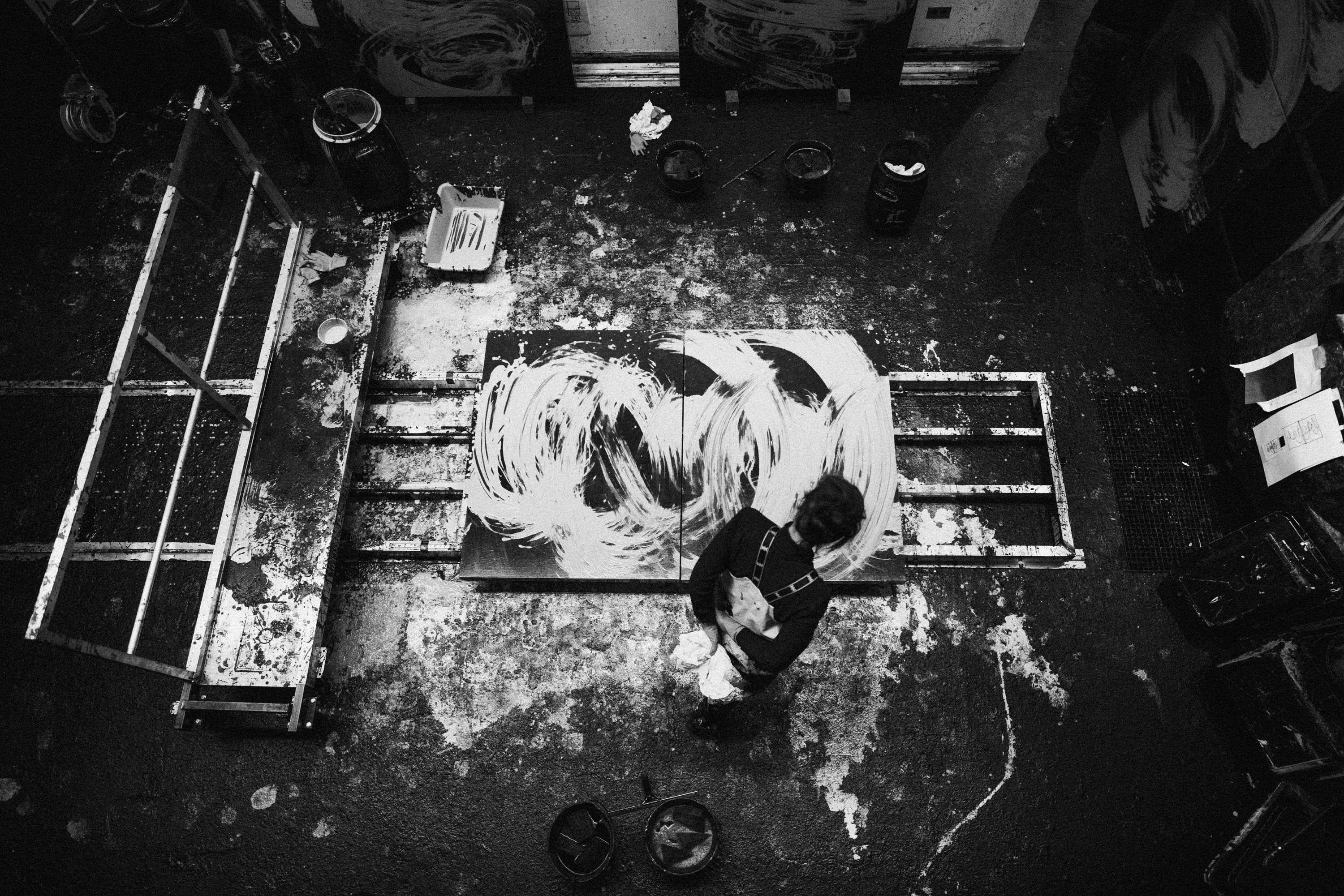
The scale engages the whole body, transforming gesture into a trajectory, time into layers. I paint standing up, directly onto the canvas, guiding my brushes using a bicycle handlebar. This scale allows for speeds, amplitudes and inertia that an easel format cannot offer. The tool becomes a choreographic partner: rotation, pendulum, torsion. The painting ceases to be a surface and becomes a force field. Once the painting is finished, one can read gravity, momentum, fatigue, recovery. I believe one can also perceive something that is very close to my heart: the coexistence on the canvas of the moment and duration.
You once said that discovering your new abstract language frightened you because of its power. What was so unsettling about it?
I was afraid because this language was beyond me. It revealed a power of emergence that defied our established aesthetic knowledge and also bypassed my habits and my ‘taste’. It demanded that I let go of my safeguards: style, virtuosity, recognition. This state of exposure, which consists of letting the work decide, of letting the work open up new paths of exploration for you, is dizzying. Perhaps that is where the work begins.
Fabienne, I had the chance to experience your Aria exhibition at Waddington Custot in London, where your Vortex paintings translated Mozart’s arias into spiralling forms of movement, rhythm and energy. What fascinated you about making something as invisible and immaterial as sound physically visible through painting?
Sound is already movement in the air. I wanted it to find an equivalent, a form of expression within the medium of paint. The spirals, the surges, the resonances of colour are translations of breath, of rhythm, of tension. What fascinates me is when painting does not merely illustrate music but becomes another form of it, where the eye can almost hear. Following a year-long residency at the Juilliard School in New York, where I had set up a workshop with musicians, I later organised an exhibition at the Galerie Pauli in Switzerland to present this research, titled The Eye Listens.
You once said that if a painting fails to contain “real life”, you destroy it by fire. How do you recognise the moment when a work is truly alive?
When a painting continues to surprise me even after the initial gesture, when it resists an immediate explanation, it then quite naturally manages to organise the space around it. The painting acquires an inner coherence that is not about perfection, but about rightness. If I sense rhetoric, theatricality or mere effect, I’d rather burn it. Fire reintroduces reality where there was only mimicry.
Your practice often feels closer to a form of meditation or devotion than to a conventional studio process. What kind of mental state are you searching for before beginning a painting?
I am seeking a form of void that is both contemplative and active. I try to put myself in a mindset that allows me to slow down, to synchronise my breath with my gaze, and to listen to the texture and poetry of the day. Sometimes a walk, sometimes a few ink strokes to attune the body. The aim is to be sufficiently available so that the first mark is necessary, inspired, and not merely decorative.
After everything you have learned through painting, what still remains a mystery to you?
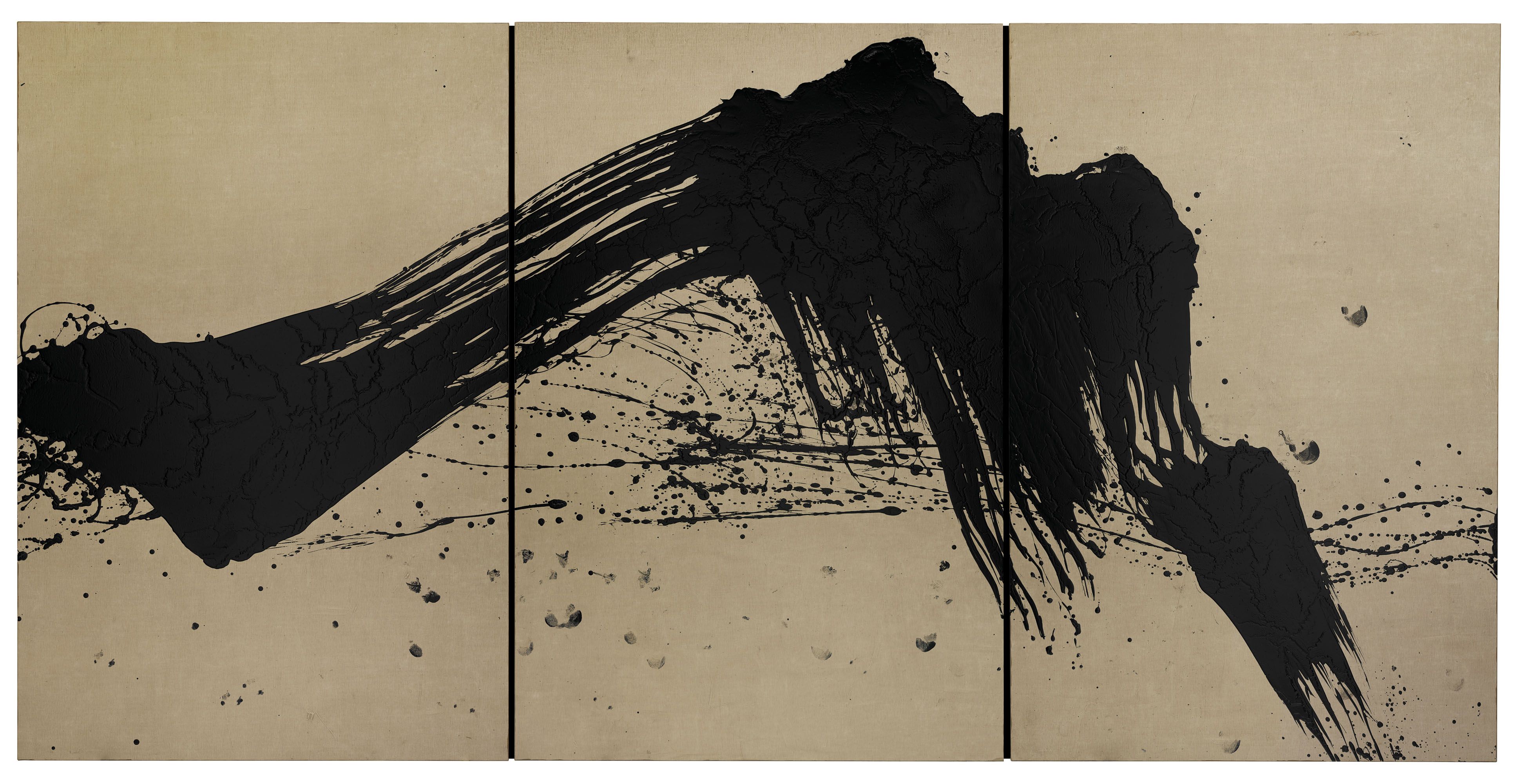
The moment when matter changes state and becomes presence. Why, out of a hundred gestures, only one opens the door. The exact relationship between chance and choice. This mystery suits me. It keeps the studio alive; it compels me to remain a student of painting. At some point, I would like to confront the representation of the body, which for me remains a living mystery to be explored.


